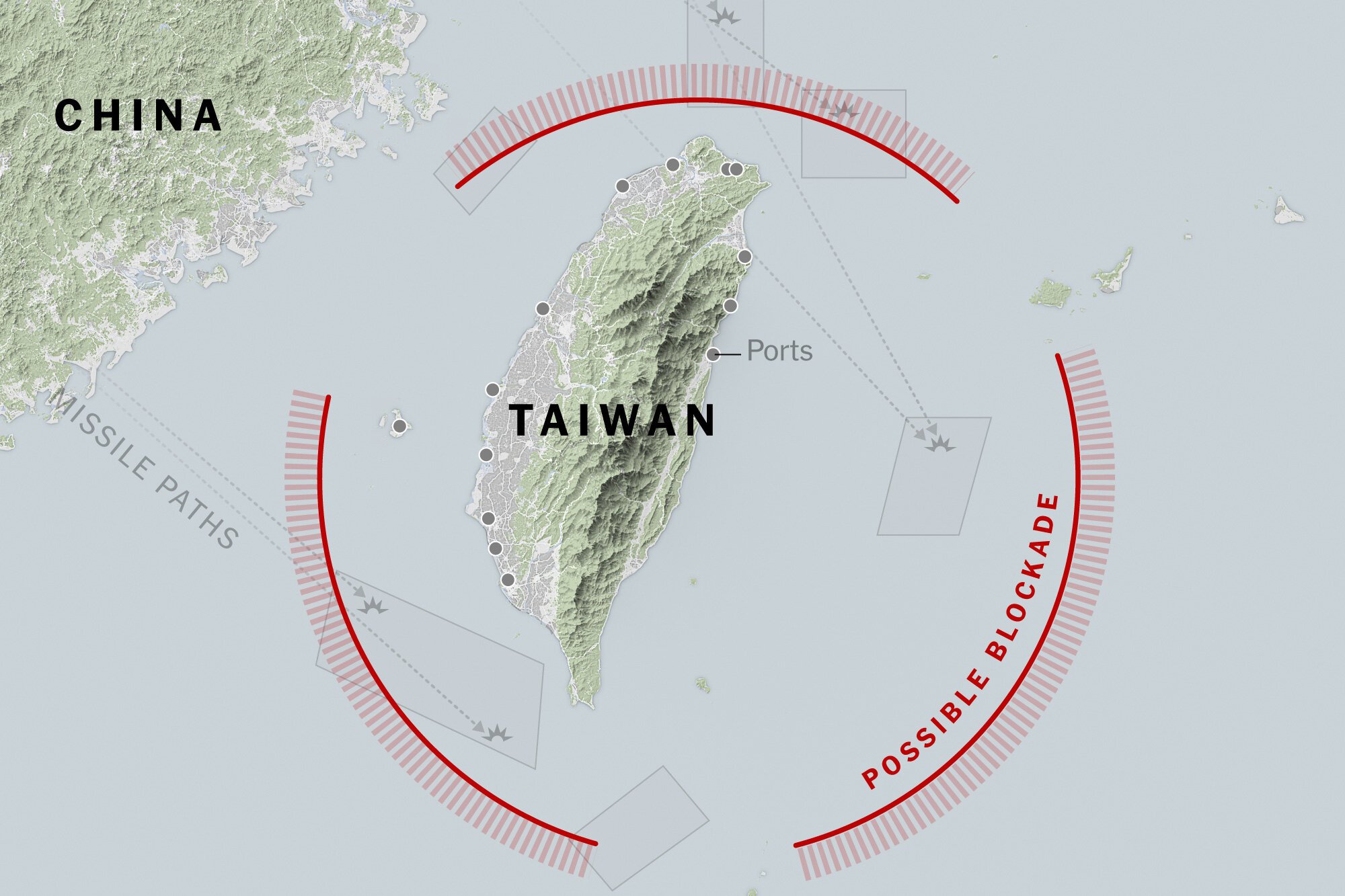
Will China blockade Taiwan by June 30?
Will China blockade Taiwan by June 30?
New here?
Understand this market
This market asks whether China will physically cut off Taiwan's access to the outside world — stopping ships and planes from getting in or out — before the end of June 2026. A Yes means a real blockade: foreign cargo ships and commercial flights are actually blocked from reaching Taiwan's main ports and airports by Chinese military force. A No means that does not happen, even if tensions stay high or China runs military exercises near Taiwan.
Order Book
Will China blockade Taiwan by June 30?
Resolution Criteria
This market will resolve to "Yes" if China (People's Republic of China) announces it has established or otherwise de facto establishes an arial or naval blockade for the territory of Taiwan (Republic of China) by June 30, 2026, 11:59 PM ET. Otherwise, this market will resolve to "No". A qualifying blockade is: - Prevents the normal ingress or egress of foreign commercial traffic to or from Taiwan Island’s main ports or airports by threat or use of force for ≥ 24 hours. - Covers part or whole of the main island of Taiwan (Formosa). - Is declared and enforced, de facto (e.g., it is established that China is blocking a significant portion of foreign commercial traffic, as described above, by a wide consensus of credible reporting regardless of whether China has issued a statement or not), or China-issued navigation/airspace prohibitions covering Taiwan's main island's approach lanes that are actively enforced so that most foreign commercial access is denied. A qualifying blockade is not: - Military or naval exercises or drills (established with warning areas or NOTAMs that do not actively stop third-country ships/aircraft and do not materially deny access). - Purely economic or coercive measures (e.g., sanctions, customs delays, fishing bans, cyber/GPS jamming) without physical interdiction or enforced closure). - Weather/accident-related closures or voluntary rerouting by operators absent PRC enforcement. - Islet-only incidents that do not involve the main island of Taiwan. - Seizure or inspection of a single vessel/aircraft by itself, unless part of an enforced pattern that denies access as defined above. The resolution source for this market will be a broad consensus of credible reporting.
Read the full market guide →Prediction markets currently show this outcome as very heavily concentrated on 'No' — a Chinese blockade of Taiwan by 30 June 2026 is the marginal, heavily minority-backed outcome in current trading. The market defines a qualifying blockade as a sustained physical interdiction of foreign commercial traffic to Taiwan's main island for at least 24 hours, enforced by the People's Republic of China. Resolution would be determined by a broad consensus of credible reporting before the 30 June 2026 deadline.
Market structure
This is a binary yes/no market with a single outcome tracked. Volume is overwhelmingly concentrated on the 'No' side, making this a strongly asymmetric market. Resolution requires credible consensus reporting of a sustained, physically enforced blockade of Taiwan's main island — not exercises, sanctions, or single-vessel incidents. The deadline is 30 June 2026. There is no fallback or contingency mechanism specified beyond that date.
Background
Cross-Strait tensions have been a persistent feature of Indo-Pacific geopolitics since 1949, with the People's Republic of China maintaining that Taiwan is a breakaway province subject to eventual reunification. Military activity around Taiwan has intensified in recent years, with the People's Liberation Army conducting large-scale exercises — notably in August 2022 following a high-profile visit to Taipei — that temporarily enclosed portions of the island with declared exercise zones. Those exercises stopped short of the resolution criteria here, which requires active denial of foreign commercial access. Taiwan's ports and airports handle substantial international trade and transit traffic, meaning a full blockade would constitute a major act of economic and military coercion with significant global ramifications.
Key factors
Several structural factors bear on whether this market resolves 'Yes'. First, the resolution criteria set a high bar: passive exercises or warning zones do not qualify — actual physical interdiction of third-country commercial vessels or aircraft must be established. Second, the timeline is short; significant military operations of this nature typically require visible preparatory mobilisation detectable by satellite and signals intelligence, providing some lead time. Third, diplomatic and economic interdependencies — including China's own trade relationships and the risk of international sanctions — create disincentives for escalation to a formal or de facto blockade. Fourth, the involvement of US naval forces under treaty commitments and informal security assurances introduces a deterrence calculus that historically has restrained kinetic escalation. Fifth, domestic political calendars on both sides of the strait and in Washington could shift incentive structures, as could unexpected flashpoints such as arms sales announcements, leadership transitions, or incidents at sea. Any single-vessel seizure or localised islet incident would not meet the threshold absent an enforced systemic pattern.
FAQ
How is the 'Will China blockade Taiwan by June 30?' market resolved?
Resolution requires a broad consensus of credible reporting confirming that China has established — by declaration or de facto enforcement — a sustained blockade of Taiwan's main island that physically denies most foreign commercial access by sea or air for at least 24 hours. Exercises, sanctions, and single-vessel incidents do not qualify.
When does the China blockade Taiwan market resolve?
The market resolves on or before 30 June 2026 at 11:59 PM ET. If no qualifying blockade has been established and reported by that deadline, the market resolves 'No'. There is no specified extension or fallback beyond that date.
Would Chinese military exercises around Taiwan count as a blockade for this market?
No. Military exercises or drills — even large-scale ones with declared warning zones or NOTAMs — do not qualify unless they actively and physically stop third-country ships or aircraft and credibly deny most foreign commercial access to Taiwan's main island. Voluntary operator rerouting absent PRC enforcement also does not qualify.
What does the market currently show for a China–Taiwan blockade?
Trading is overwhelmingly concentrated on the 'No' outcome. A qualifying blockade before 30 June 2026 is the marginal, very lightly backed position, making this one of the most asymmetric binary markets currently active on cross-strait scenarios.
Paridesk is not a regulated financial advisor. The information above is for informational purposes only and does not constitute financial, investment, or trading advice. Prediction markets carry risk of total loss. Past patterns do not guarantee future outcomes.
Related Markets




Will China blockade Taiwan by June 30?
1%